China-Tajikistan International Digital Corridor Launched, Building Digital Silk Road Across the Pamirs
2026-10-31 16:45:00
114
According to a report by the Asia-Plus News Agency, the inauguration ceremony of the China-Tajikistan International Digital Corridor was recently held at the Communications Service of Tajikistan. Representatives from Tajiktelecom and China Mobile International signed the project document and jointly pressed the launch button, realizing a direct network connection between the two countries via the Kulma-Karasu Port on the Tajik-Chinese border.
Implemented under the framework of Tajikistan’s *National Development Strategy through 2030* and *Communications Industry Development Strategy through 2040*, the project is a key step for Tajikistan to break its international communication bottleneck and evolve into a transit node of the Digital Silk Road. It will support the country’s goal of lifting the total capacity of international communication channels to 2 terabits per second by 2030.
A Fiber Trunk Traversing High Mountain Terrain
The Dushanbe-Khorog-Kulma fiber optic trunk line stretches 1,010 kilometers, with 435 kilometers running through the highlands of Badakhshan. It connects with China’s network at the 4,363-meter-high Kulma Pass, becoming Tajikistan’s fifth international communication access point.
The first phase adopts 16-core optical cables and Dense Wavelength Division Multiplexing (DWDM) equipment, delivering an initial transmission capacity of 1 Tbps, which can immediately divert part of the country’s international traffic. The infrastructure reserves ample expansion room: with upgraded multiplexing platforms in the coming years, the line’s capacity will reach 10 Tbps, with a long-term potential of hundreds of terabits per second.
Direct Connection to HKIX for Improved Internet Performance
Through the corridor, Tajikistan’s telecom network is directly connected to the Hong Kong Internet Exchange (HKIX), one of Asia’s largest internet exchange points, significantly shortening the network path to China and major global services:
- More stable access to e-commerce platforms, lifting cross-border trade efficiency;
- Lower latency for mainstream cloud providers, facilitating enterprise cloud adoption;
- Significantly enhanced experience for video streaming and online gaming.
Consolidating Central Asia’s Digital Hub Status
A representative from China Mobile International stated that the corridor is a key milestone in the layout of Central Asian digital infrastructure and a pragmatic delivery of the Digital Silk Road initiative. Tajiktelecom emphasized that the project consolidates Tajikistan’s status as a digital hub in Central Asia. Coupled with the government’s dedicated sites and preferential policies for data center construction, Tajikistan is expected to grow into a key regional hub for artificial intelligence.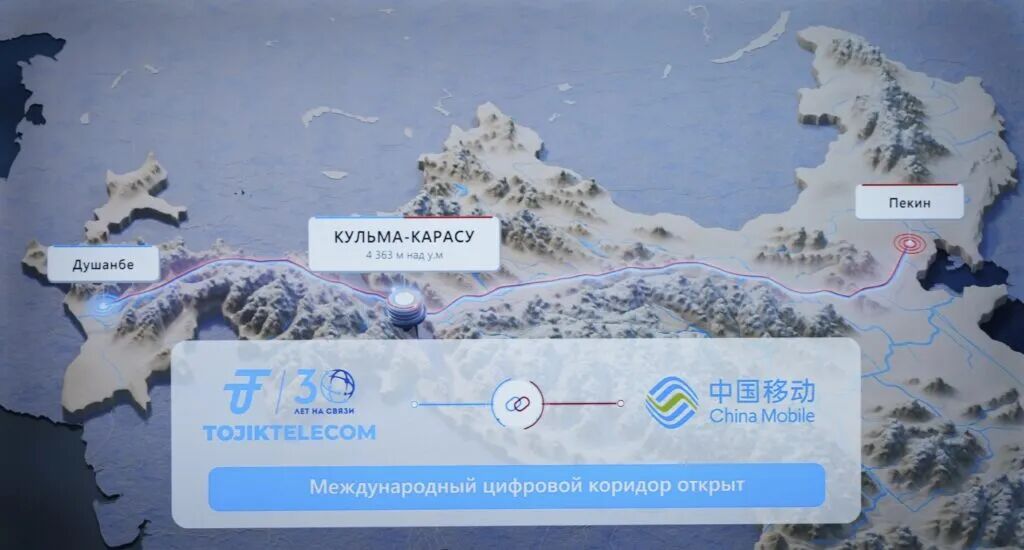
Latest articles